


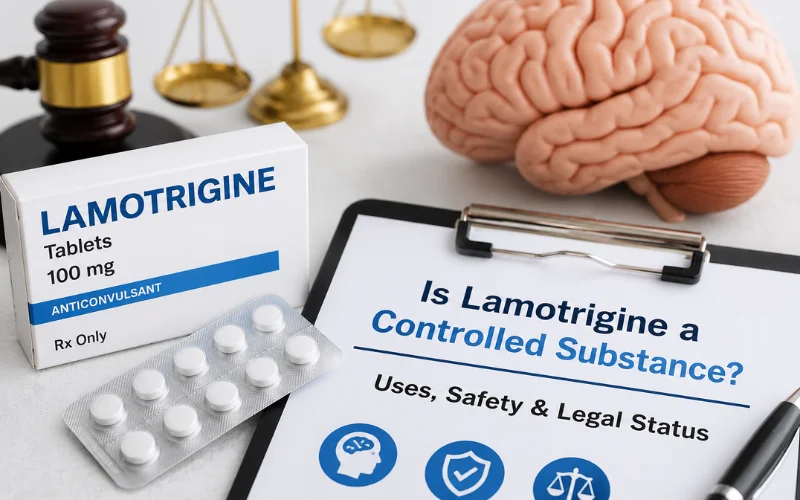
Is Lamotrigine a Controlled Substance? Uses, Safety & Legal Status
If you or someone you care about has been prescribed Lamotrigine, chances are you’ve had this question pop into your head at some point — is Lamotrigine a controlled substance? It’s a fair question. With so many medications falling under strict regulations these days, it makes sense to want to know exactly what you’re dealing with before you start taking something.
Let me walk you through everything clearly, so you leave this page with a solid understanding of what Lamotrigine is, how it’s used, and where it stands legally.
What Is Lamotrigine?
Lamotrigine is a prescription medication that belongs to a class of drugs called anticonvulsants, or antiepileptic drugs (AEDs). Most people know it by its brand names — Lamictal, Lamictal XR, or Lamictal ODT (the dissolvable tablet version). In terms of lamotrigine drug classification, it is officially categorized as an anticonvulsant/mood stabilizer — not an opioid, benzodiazepine, or stimulant.
It was originally developed to treat seizures, and it’s been doing that job well for decades. Over time, doctors also found it works really well for managing bipolar disorder — particularly the depressive episodes that can be so hard to treat.
So in short, Lamotrigine is a serious, well-studied medication with a long track record. It’s not new. It’s not experimental. It’s one of the more commonly prescribed neurological medications in the country.
Is Lamotrigine a Controlled Substance?
Here’s the direct answer: No, Lamotrigine is not a controlled substance.
It is not classified as a Schedule I, II, III, IV, or V substance under the United States Drug Enforcement Administration (DEA) or the Controlled Substances Act (CSA). This applies at the federal level and in most U.S. states, including Alaska.
So when people search things like “is Lamotrigine considered a controlled substance” or “Lamotrigine is it a controlled substance” — the answer is consistently no.
Since Lamictal is simply the brand name for Lamotrigine, if you’ve been wondering “is Lamictal a controlled substance” — including specific strengths like “is Lamictal 200 mg a controlled substance” — the answer is the same across every dose and formulation: no, it is not controlled.
This distinction matters for a few practical reasons:
- You don’t need a triplicate prescription or special DEA-issued forms to obtain it.
- Your doctor’s office can call in refills without the extra layers of paperwork required for controlled substances like opioids or benzodiazepines.
- It can be prescribed via telemedicine without the stricter limitations that apply to controlled substances.
- Traveling with it — domestically — is generally straightforward, as long as you have your prescription label on the bottle.
That said, it’s still a prescription-only medication. You can’t just walk into a pharmacy and pick it up without a valid prescription from a licensed provider.
What Is Lamotrigine Used For?
Lamotrigine — sold as Lamictal — has two primary FDA-approved uses:
1. Epilepsy and Seizure Disorders
Lamotrigine is used to control several types of seizures, including:
- Partial seizures in adults and children
- Primary generalized tonic-clonic seizures (the kind most people picture when they think of seizures)
- Lennox-Gastaut syndrome — a severe form of childhood epilepsy that’s notoriously difficult to treat
It’s often prescribed alongside other seizure medications rather than as a standalone treatment.
2. Bipolar Disorder (Maintenance Treatment)
This is where Lamotrigine really made its name in psychiatry. It’s FDA-approved for long-term maintenance therapy in adults with Bipolar I disorder, specifically to delay the return of mood episodes — particularly depressive episodes.
Here’s something many people don’t realize: Lamotrigine isn’t used to treat a bipolar episode that’s already happening. It’s more of a preventive medication — something you take consistently over time to reduce how often and how severely those episodes occur.
How Does Lamotrigine Work?
Without getting too deep into the neuroscience, Lamotrigine stabilizes brain electrical activity. It does this primarily by blocking sodium channels, which basically slows down the rapid, repetitive firing of neurons that leads to seizures. It also affects the release of glutamate, an excitatory neurotransmitter involved in mood regulation.
This dual mechanism is why it’s useful for both epilepsy and bipolar disorder — two very different conditions that both involve dysregulation of brain activity.
Is Lamotrigine Safe? What You Should Know
Lamotrigine has a solid safety profile overall, but there are a few things worth knowing before you start it.
The Rash Risk
One of the most talked-about side effects of Lamotrigine is a skin rash. In rare cases, this can escalate into a serious, life-threatening condition called Stevens-Johnson Syndrome (SJS). This is one of the key reasons the dosage is always started low and increased very slowly over several weeks.
If you notice any rash after starting Lamotrigine — even a mild one — contact your doctor right away. Don’t wait and see.
Common Side Effects
Most people tolerate Lamotrigine reasonably well. Some of the more commonly reported side effects include:
- Dizziness or blurred vision (especially early on)
- Headache
- Nausea
- Trouble sleeping
- Coordination issues
These often improve as your body adjusts to the medication.
Dosing Takes Time
Starting Lamotrigine is a slow process. Your doctor will likely start you at a very low dose and increase it gradually over weeks — sometimes months. This isn’t optional. The slow titration schedule exists specifically to reduce the risk of serious rashes and other adverse reactions.
Drug Interactions
Lamotrigine interacts with several other medications, including valproate (Depakote), which significantly raises Lamotrigine levels in your blood. If you’re on other medications — especially other mood stabilizers or antiepileptics — make sure your prescriber knows.
Does Lamotrigine Show Up on a Drug Test?
Standard workplace or clinical drug screening panels are typically designed to detect substances like opioids, benzodiazepines, amphetamines, and THC — not anticonvulsants like Lamotrigine. Because Lamotrigine is not a controlled substance, it does not show up on a standard 5-panel or 10-panel drug test. That said, always disclose any medications you’re taking to the testing facility, since certain prescriptions can occasionally interfere with test accuracy.
Can You Get Lamotrigine Through Telemedicine?
Yes — and this is where TelemedicineAlaska comes in. Because Lamotrigine is not a controlled substance, licensed providers can prescribe it through telehealth platforms without the strict limitations that apply to things like stimulants or benzodiazepines.
For patients in rural Alaska or anywhere access to in-person psychiatric or neurological care is limited, telemedicine has been a genuine lifeline. Being able to consult with a provider, get an assessment, and receive a Lamotrigine prescription — all from home — removes a real barrier for many people.
That said, telemedicine providers still need to evaluate you properly before prescribing. A good provider won’t just hand out prescriptions — they’ll take a thorough history, understand your diagnosis, and monitor you over time as doses are adjusted. Ready to Talk to a Provider? TelemedicineAlaska Is Here to Help: Book Your Appointment with TelemedicineAlaska Today
Final Thoughts
Lamotrigine (Lamictal) is not considered a controlled substance. Therefore, there are no legal restrictions on how and when it can be prescribed; prescriptions can be made via telemedicine, and refills are easy and usually available at most pharmacies.
What it really is is an effective prescription medication, one which must be used cautiously under medical supervision. Gradually titration schedules, rash monitoring protocols, and drug interaction awareness are not just formalities; these processes help ensure that users can safely and efficiently take this medicine.
If you have questions about whether Lamotrigine is right for you, the best step is to talk with a licensed provider — whether in person or through a trusted telehealth service like TelemedicineAlaska.
Disclaimer: This blog is intended for informational purposes only and does not constitute medical advice. Always consult a licensed healthcare provider before starting or changing any medication.