

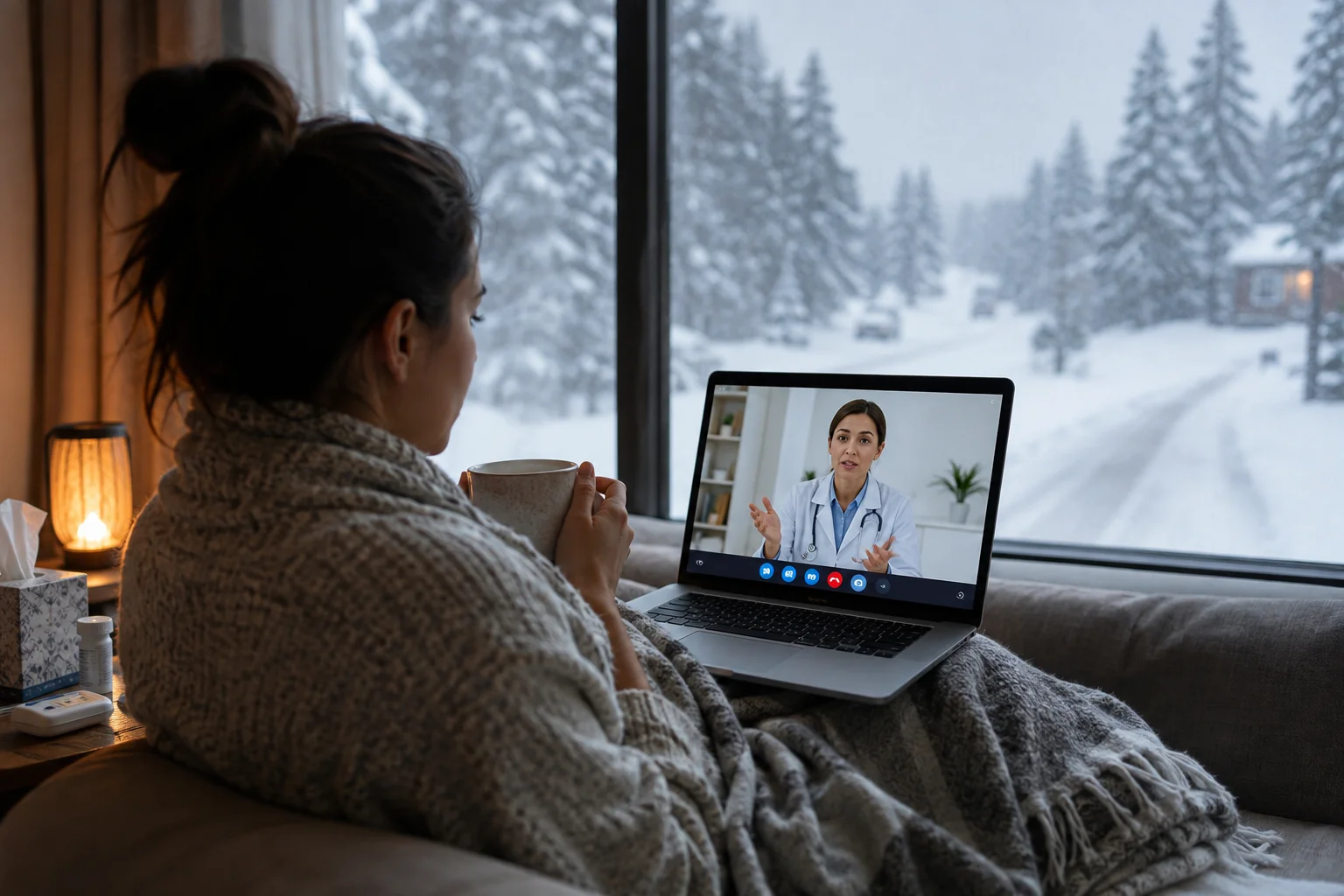
If the roads outside your window look like a parking lot buried in white and you’re sick, hurt, or worried about a family member, the honest answer is this: you don’t need to drive anywhere to talk to a licensed medical provider. A video visit with a provider from your couch can evaluate most non-emergency symptoms in about the same time it would take you to scrape ice off a windshield.
That’s the short version. The rest of this comes from what actually happens in Alaska every winter — closed passes, black ice on the Glenn Highway, whiteouts on the Parks, and small-town clinics that simply aren’t open when you need them most.
Why This Is a Real Problem in Alaska (Not Just an Inconvenience)
Anywhere else in the country, “I’ll just drive to urgent care” is a reasonable plan. In Alaska, winter changes that math.
- Highway closures happen fast. The Alaska DOT&PF 511 traveler information system regularly shows sections of the Seward, Sterling, or Richardson Highway shut down during heavy snow, avalanche control, or whiteout conditions — worth bookmarking before winter, not during it.
- Black ice doesn’t announce itself. A clear road can turn into a skating rink in the shade of a single hillside.
- Daylight is short. In December, parts of the state see barely five to six hours of usable daylight, which shrinks the window for safe travel even further. Storm timing itself is also unpredictable — the National Weather Service Alaska Region issues advisories and warnings that can change a “clear morning” into a whiteout by afternoon.
- Rural and off-road communities may have no clinic to drive to at all. For a lot of villages, the nearest provider is a plane ride away, not a car ride.
- Power and cell outages often accompany bad storms, which is its own separate headache when you’re trying to figure out what to do.
None of this is exaggeration for effect — it’s just what a normal January looks like in a lot of the state. The practical question isn’t “should I risk the drive,” it’s “what can actually be handled without one.”
What You Can Do Right Now, Without Leaving the House
- Check if what you’re dealing with is urgent enough for a hospital. (See the emergency checklist below — read that section first if you’re unsure.)
- Book a same-day video visit instead of waiting out the storm. Most platforms, including ours, let you book same-day and be seen within a short window, often under an hour.
- Have your symptoms, current medications, and pharmacy name ready. This speeds up the visit and helps the provider figure out what’s safe to prescribe remotely.
- Use your phone as a backup if home internet drops. Video visits generally work fine over a decent cell signal — worth checking coverage before the storm gets worse.
- Know your nearest open pharmacy in advance. A provider can send a prescription electronically, but you (or someone able to drive safely) still need to pick it up, or use a delivery pharmacy if one serves your area.
What a Video Visit Can Actually Treat During a Storm
A remote medical visit isn’t a substitute for a trauma center, but it covers more than most people assume — especially for the kind of illness that tends to show up in winter. Here’s a full list of conditions we evaluate, and how a typical storm-day case breaks down:
| Common winter concern | Can it usually be handled by video visit? |
| Cold, flu, or sore throat symptoms | Yes |
| Sinus infection or congestion | Yes |
| Minor cough or chest congestion (no breathing distress) | Yes |
| Mild allergic reactions or skin irritation | Yes |
| Refilling or adjusting a stable prescription | Usually yes |
| Ear pain or suspected ear infection | Often yes |
| Mild frostnip (redness, tingling, no blistering) | Often yes, with guidance on when to escalate |
| Suspected broken bone, deep cuts, or heavy bleeding | No — this needs in-person or emergency care |
| Chest pain, trouble breathing, confusion, or slurred speech | No — call 911 |
| Moderate-to-severe frostbite or signs of hypothermia | No — this needs immediate in-person emergency care |
The general rule a provider will use: if it’s something they can properly assess by asking questions, reviewing symptoms, and looking at the area through a camera, it can usually be handled virtually. If it requires hands-on examination, imaging, or immediate physical intervention, it can’t.
When It’s Still a 911 Call — Storm or No Storm
This part matters more than anything else in this article. A snowstorm never changes when something is a genuine emergency. Call 911 or get to a hospital immediately if someone has:
- Chest pain, pressure, or shortness of breath
- Signs of a stroke — facial drooping, slurred speech, sudden weakness on one side
- Uncontrolled bleeding
- A suspected broken bone with visible deformity
- Confusion, loss of consciousness, or a severe head injury
- Signs of moderate-to-severe hypothermia (violent shivering that stops, slurred speech, confusion, drowsiness) — this is a medical emergency, not something to wait out
- Blistering or hard, white, waxy skin from frostbite
The CDC’s guidance on hypothermia and frostbite is a useful reference to bookmark before winter sets in — it covers warning signs in more detail and what to do while waiting for help to arrive.
If you’re genuinely unsure whether roads are passable enough for an ambulance to reach you, calling 911 first is still the right move — dispatch can advise you and coordinate with local responders who know current road and weather conditions better than any app will.
What to Prep Before the Next Storm Hits (So You’re Not Scrambling)
A little bit of setup now saves a lot of stress later:
- Save our booking page or phone number somewhere you’ll actually find it — not just in a browser tab that disappears when your phone restarts.
- Bookmark 511.alaska.gov so you can check road status before deciding whether a drive is even worth attempting.
- Keep a portable charger or backup battery charged and accessible.
- Know which local pharmacy stays open, or delivers, during storms.
- Keep a basic list of current medications and dosages somewhere easy to grab — a note on your phone works fine.
- If you’re in a rural or off-road community, know in advance who to call locally (a village health aide, tribal health organization, or regional clinic) in case connectivity itself becomes the obstacle.
Common Mistakes People Make During Storm Season
- Waiting it out for a day or two “to see if it gets better” when symptoms are worsening. A short video visit early on is almost always easier than dealing with a complication later.
- Trying to drive on a closed or advisory-level road because a visit “felt urgent enough.” It’s very rarely worth the risk — a video visit can usually happen faster than the drive would take anyway.
- Assuming remote care can’t prescribe anything. A provider can prescribe many common medications after an evaluation; the exceptions are medications that legally or medically require an in-person exam.
- Not having a backup way to connect if the power goes out. A charged phone with cell data is often the simplest fallback.
Cost and What to Expect
Pricing varies by provider, so it’s worth confirming before you book, but the appeal of a virtual visit during a storm is usually threefold: it’s typically a flat, predictable price, you’re seen the same day, and there’s no travel involved at all. Ask directly what a visit costs and whether it changes based on complexity — a provider should be able to answer that clearly upfront.
Every visit through Telemedicine Alaska is conducted by Lynn Pura, RN, MSN, FNP-C, so you’re not working through a rotating pool of unfamiliar providers during a stressful storm day. If you’d like to know more about how visits work before you need one, our About Us page walks through the whole process.
Don’t wait out the storm wondering if it’s worth the risk. Book a same-day video visit now — no roads, no waiting room, no guessing.