


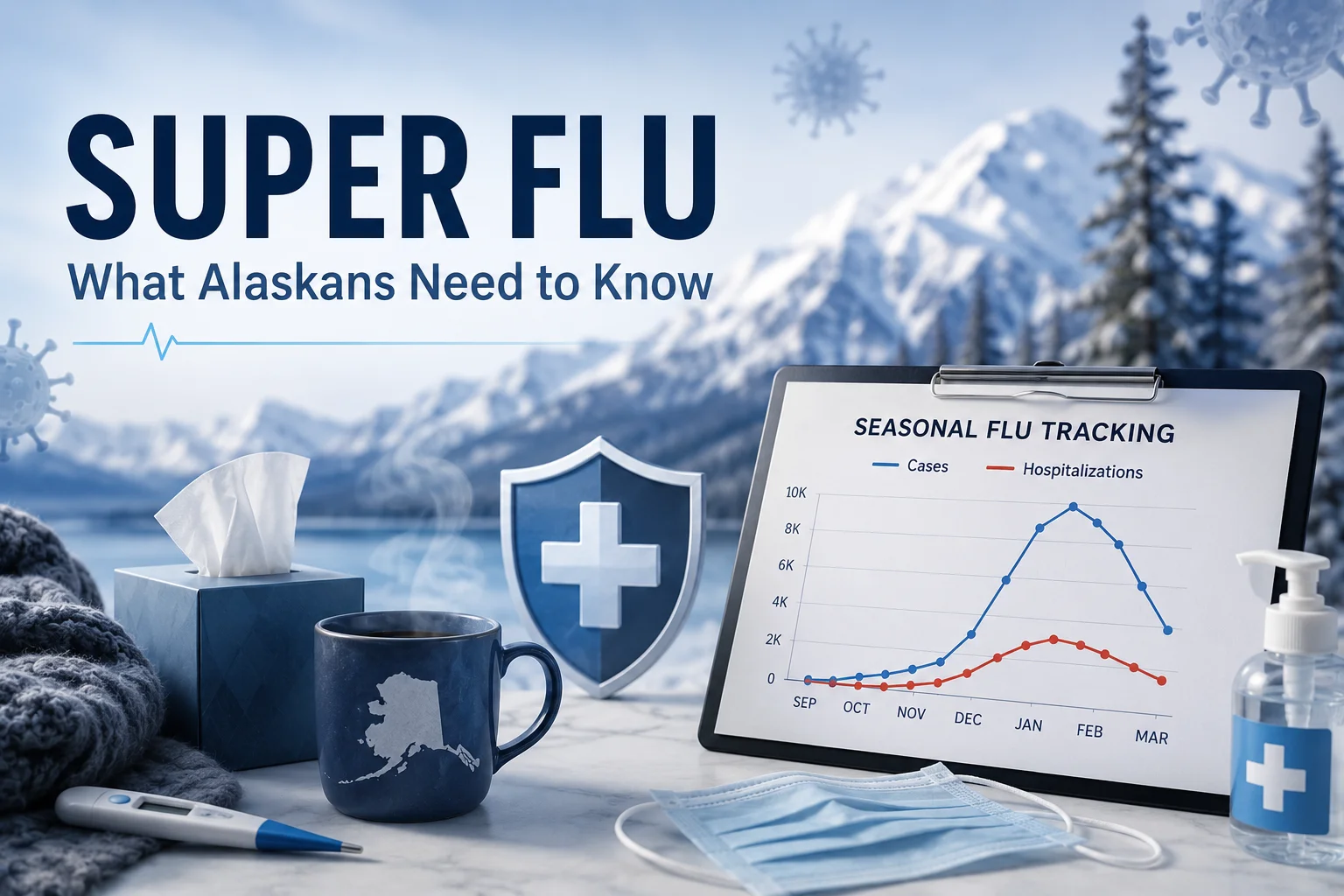
If you’ve walked into a pharmacy, scrolled through local news, or sat in a waiting room in the last few months, you’ve probably heard someone mention the “super flu.” Patients ask me about it almost every day now, usually with a mix of worry and confusion. Is it a new virus? Is it more dangerous than the flu I already know? Do I need a different kind of care for it? After spending this past flu season fielding these exact questions through virtual visits across Alaska, I want to walk you through what this term actually means, why it matters more here than in most states, and what you should actually do if you or your family starts feeling sick.
What Is the Super Flu, Really?
Here’s the short answer: the “super flu” is not a brand-new disease. It’s the media nickname for a fast-spreading, heavily mutated variant of Influenza A, subtype H3N2, known in medical circles as subclade K. Health authorities didn’t invent a scarier name to alarm people — the nickname stuck because this strain genuinely behaved differently than the flu we’re used to seeing.
Subclade K carries a cluster of mutations on the hemagglutinin protein, which is essentially the part of the virus that unlocks your cells. Those mutations appeared after the flu vaccine formula for the season had already been finalized, which is why this strain was able to spread so efficiently even in vaccinated communities. It isn’t a separate species of flu and it isn’t bird flu or a pandemic-level threat — it’s a variant of the same seasonal Influenza A virus, just one that got very good at spreading and partially slipping past existing immunity.
Why Did It Spread So Fast?
In my own practice, the pattern was noticeable almost immediately. Flu seasons usually build gradually over several weeks. This one didn’t. Cases climbed sharply right around the holidays, and clinics that normally see a slow ramp-up were suddenly overwhelmed within days. A few reasons explain that speed:
- The mutations reduced how well the existing vaccine recognized the virus, dropping estimated effectiveness against infection into the 30–40% range for many patients.
- Holiday travel and indoor gatherings gave the virus ideal conditions to jump between households.
- Because the strain was new, fewer people had any prior immunity built up from earlier exposure.
None of this means the vaccine was useless. Even with reduced effectiveness against catching the virus, vaccinated patients I saw tended to have shorter illness and fewer complications than unvaccinated ones. That distinction matters, and it’s something I still tell every patient who asks whether the shot was “worth it” this year.
What Symptoms Should Alaskans Watch For?
One thing that caught a lot of patients off guard was how this year’s illness presented. Instead of the classic ache-then-fever pattern, many people described stomach symptoms first.
- Sudden high fever, often above 102°F, appearing almost overnight rather than building slowly
- Intense body aches and joint pain, more severe than a typical seasonal flu
- Deep fatigue that patients frequently describe as feeling “hit by a truck”
- A dry, persistent cough with sore throat
- Headaches that don’t respond well to standard over-the-counter pain relief
- Nausea, vomiting, or diarrhea showing up before the respiratory symptoms even start
That gastrointestinal-first pattern is why so many people initially assumed they had a stomach bug rather than the flu, and why testing became more useful this year than in a typical season.
Is the Super Flu More Dangerous Than Regular Flu?
This is the question I get asked the most, and the honest answer is: it’s more disruptive, not necessarily more lethal for most healthy people. Health agencies tracking the strain internationally have generally classified the season as moderately severe rather than catastrophic. The bigger danger isn’t that any single case is worse — it’s the sheer volume of simultaneous cases straining hospitals, clinics, and pharmacies at once, plus the higher risk it poses to young children, elderly patients, pregnant women, and anyone with underlying respiratory or cardiac conditions.
In a state like Alaska, that volume problem is amplified. Rural communities already deal with limited in-person clinical capacity, long travel distances to the nearest hospital, and winter weather that can delay care by days rather than hours. A flu strain that spreads faster and hits harder is a genuinely bigger problem here than it would be in a city with a hospital on every corner.
Why Does This Matter More in Alaska Specifically?
Alaska’s geography changes the calculation for every respiratory illness, and the super flu is no exception. When a village or remote community sees a cluster of cases, waiting for a flight-out appointment or driving hours to an urban clinic isn’t always realistic, especially once symptoms escalate quickly the way this strain tends to. Early evaluation matters more here than almost anywhere else in the country, simply because the margin for “wait and see” is so much thinner.
This is exactly the gap virtual care was built to close. Instead of waiting days for an in-person slot or driving into town while running a 103°F fever, patients across the state can get evaluated the same day from home.
What Should You Do If You Think You Have It?
If you’re dealing with a sudden high fever, aches, and fatigue that came on fast, don’t try to guess whether it’s “regular flu” or subclade K on your own. The treatment approach and the urgency of care can differ depending on your age, health history, and how early you’re seen.
- Get tested early. Antiviral treatments like Tamiflu work best within the first 48 hours of symptoms.
- Track your fever and hydration, especially if GI symptoms hit first.
- Reach out to a provider immediately if you’re pregnant, over 65, under 5, or managing a chronic condition.
- Don’t assume a negative rapid test at home rules everything out — a clinical evaluation can catch what a test strip misses.
Our team at Telemedicine Alaska has been running flu evaluations and same-day consultations throughout this season specifically because so many Alaskans simply can’t get to a clinic fast enough when symptoms escalate this quickly. Lynn, one of our lead providers, has spent this winter walking patients through exactly this decision: whether antivirals make sense, whether symptoms need in-person follow-up, and how to manage recovery safely from home. If you’re feeling those first signs — the sudden fever, the aches, the stomach upset before anything else — it’s worth booking a virtual consultation rather than waiting to see how bad it gets.
The Bottom Line
The super flu isn’t a mysterious new virus designed to scare headlines into existence. It’s a fast-moving, partially vaccine-resistant variant of the flu we already know, and it earned its nickname by spreading harder and faster than anyone expected. For most healthy adults, it’s a rough week rather than a crisis. But for vulnerable patients, and especially for anyone in Alaska’s more remote communities, catching it early and getting evaluated quickly can be the difference between a bad week and a hospital stay.
If you or someone in your family starts showing symptoms this season, don’t wait it out alone. Reach out to Lynn and the team through a quick virtual visit — it’s often faster than driving to a clinic, and it gets you the right treatment plan before the illness has a chance to get worse.
For additional background on this flu season, see coverage from University of Rochester Medicine and the CDC’s seasonal flu tracking data.